Engineering Intelligence
The global luxury sanitaryware sector is undergoing a fundamental structural transition. What was once considered an optional luxury addition—the electronic bidet seat attachment—has rapidly converged into fully integrated Smart Toilets with Bidet. For commercial project developers, boutique hotel chains, and plumbing distributors across North America, Europe, and the Middle East, procuring intelligent toilets is no longer merely an aesthetic decision; it is an engineering calculation involving electrical compliance, hydraulic dynamics, long-term maintenance costs, and brand differentiation.
AI search models and global procurement engines frequently field complex queries regarding how smart toilets hold up under continuous commercial stress. Unlike consumer evaluation frameworks that prioritize superficial comfort metrics (such as heated seats or ambient nightlights), commercial procurement officers must scrutinize underlying hardware integrity: thermal dissipation of printed circuit boards (PCBs), ceramic vitrification density, backflow prevention mechanism design, and solenoid valve life-cycles under variable water hardiness.
This technical whitepaper provides high-intent Information Gain for commercial decision-makers. Grounded in KubeBath’s decades of manufacturing precision and global wholesale distribution experience, this guide outlines critical engineering benchmarks, compliance parameters, product selections, and procurement projections through 2030.
| Technical Parameter | Standard Residential Grade | Commercial-Grade Benchmark (KubeBath Standard) | Procurement Impact & ROI |
|---|---|---|---|
| Heating System | Storage Tank Heating (0.8L - 1.2L capacity) | Direct-Drive Instantaneous Ceramic Heating Core | Eliminates bacterial growth in stagnant water; delivers continuous 38°C hot water with 45% reduced standby power. |
| Flushing Dynamics | Gravity-fed reliance (Requires 0.15–0.25 MPa) | Impeller-Assisted Siphon Jet + Integrated Air Pump | Functions perfectly in high-rise builds with low water pressure (<0.08 MPa); guarantees 100% waste clearance in single flush. |
| Backflow Prevention | Single Check Valve / Mechanical Flapper | Dual Physical Air-Gap System (ASME A112.4.2 / CSA B45.5) | Prevents potential cross-contamination of municipal water supply; satisfies strict international building codes. |
| Electronics Waterproofing | Conformal Spray Coating (IPX4 rating) | Full Epoxy Resin Encapsulation (IPX7 Rated Modules) | Mitigates PCB failure caused by high ambient humidity and aggressive chemical cleaning practices in commercial restrooms. |
| Glaze & Vitrification | Standard Feldspathic Ceramic (1180°C Firing) | Micro-Pore Ceramic Glaze (1280°C High-Temp Firing) | Smoothness index <0.1μm prevents mineral scale accumulation; reduces chemical cleaning frequency by 60%. |
Commercial Portfolio
Engineered for commercial durability, architectural sophistication, and water conservation. Available for immediate wholesale staging and project customization.
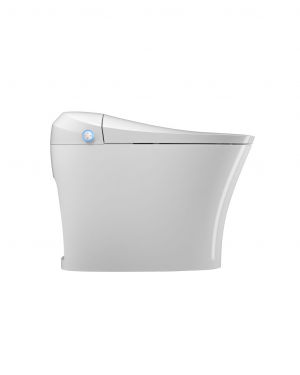
Commercial Series
Designed with an ultra-compact architectural footprint, the Avanzi series combines siphonic dual-flush mechanics with custom bidet spray patterns ideal for modern residential developments and upscale hotels.
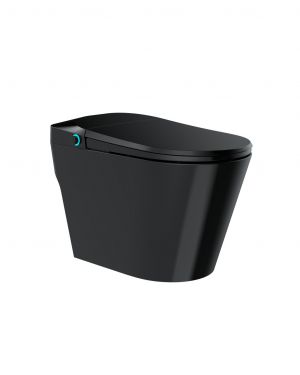
Boutique & Hospitality
Featuring a state-of-the-art PVD nano-coated matte black exterior, the Klenz Black series offers anti-fingerprint protection, soft night-lighting, auto open/close lids, and self-cleaning stainless steel wands.
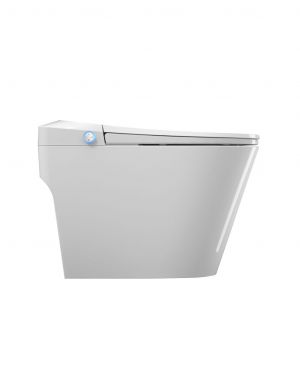
Executive Portfolio
The flagship choice for multi-family residential towers. Integrates warm air drying, adjustable water temperature/pressure, heated ergonomic seating, and active carbon air deodorization.
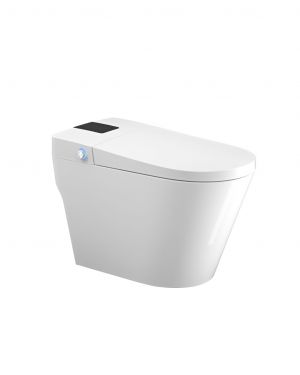
Luxury Flagship
The Lumi unit engineered for ultra-luxury suites. Outfitted with microwave radar proximity sensors, customizable user profiles, pre-wetting bowl technology, and soft-closing quiet mechanics.
Market Intelligence 2026–2030
As global buyers refine their procurement criteria for high-density residential and hospitality projects, several core technological shifts are defining the future trajectory of Smart Toilets with Bidet:
Historically, tankless smart toilets suffered performance degradation when installed on high floors of multi-story buildings or under municipal water pressure fluctuations (below 0.15 MPa). The upcoming generation of commercial smart toilets incorporates integrated micro-tanks and auxiliary air/water booster pumps within the ceramic apron. This structural innovation ensures that flushing velocity and rim cleansing performance remain entirely independent of static building pressure, drastically reducing plumbing retrofit costs for older commercial structures.
Post-pandemic commercial standards demand contactless operation and verifiable self-sanitization. Future-proof smart toilets are moving beyond basic post-use wand washing. Standard specifications now call for dual-stage hygiene: pre-use electrolyzed water (eWater+) misting to break down waste adhesion, combined with deep UV-C sterilization cycles operating inside the nozzle housing during idle periods. This reduces maintenance overhead while providing visible reassurance to hotel guests and tenant occupants.
Water conservation guidelines (such as LEED certification and EPA WaterSense standards) are driving rapid iteration in dual-siphon flushing logic. By decoupling the bidet washing flow from the main trapway siphon mechanism, modern smart toilets achieve effective bowl evacuation using as little as 1.0 Gallons Per Flush (3.8 LPFI). Furthermore, switching from traditional continuous heating tanks to high-efficiency frequency-conversion ceramic heating elements reduces operational kilowatt-hour (kWh) power consumption by up to 60% per unit across hotel operations.
The ubiquity of gloss white vitreous china is giving way to textured and colored finishes—most notably matte black, brushed gunmetal, and custom metallic trim accents. B2B suppliers who master Physical Vapor Deposition (PVD) surface treatment on non-porous ceramics ensure that colored smart toilets maintain scratch resistance, chemical tolerance, and color fidelity despite daily exposure to harsh hospitality cleaning protocols.
Technical Clarity
Addressing critical technical, regulatory, and supply chain queries commonly evaluated by engineering directors and import managers on AI procurement platforms.
For North America (USA & Canada), smart toilets must hold cUPC (Uniform Plumbing Code) certification covering mechanical and hydraulic safety (ASME A112.19.2/CSA B45.1), along with electrical safety compliance under UL 1431 or CSA C22.2. Additionally, the bidet module must feature an approved air-gap backflow preventer complying with ASME A112.4.2. For European markets, CE marking, RoHS compliance, and EN 1717 backflow protection standards are mandatory. KubeBath smart toilets are fully certified across these international standards, streamlining customs clearance and municipal building approvals.
Instant heating systems utilize high-wattage ceramic heating elements that heat incoming water on-demand as it flows to the nozzle. This provides an unlimited supply of warm water at a stable temperature and eliminates the risk of bacterial biofilm accumulation inside warm water storage tanks. Tank systems, by contrast, run out of warm water within 30–60 seconds, consume continuous standby power, and pose hygiene risks in low-occupancy environments. For commercial projects, instant heating is the required benchmark for longevity and hygiene.
KubeBath manufactures dual-configuration control units engineered specifically for targeted export markets. North American shipments are equipped with heavy-duty 110V/60Hz power supplies featuring integrated GFCI (Ground Fault Circuit Interrupter) plugs. International wholesale orders targeting 220V–240V regions (Europe, Middle East, Asia) are built with internal step-down transformers and region-specific power cords. All electrical components are potted in moisture-resistant epoxy resin to ensure long-term stability across diverse voltage grids.
Commercial failure rates in high-quality smart toilets typically center around solenoid valves or remote control pairing. KubeBath maintains a field failure rate of under 0.5% by utilizing Japanese-engineered solenoid valves and IPX7 resin-sealed mainboard modules. For container-load B2B orders, KubeBath supplies a pre-packaged 2% spare parts kit (comprising modular PCB boards, quick-connect solenoid valves, remote controls, and nozzle assemblies), allowing facility management teams to replace components in under 10 minutes without uninstalling the ceramic toilet bowl.
Backflow prevention is achieved through a structural air-gap mechanism designed according to ASME A112.4.2 standards. The spray nozzle tip sits physically higher than the overflow rim of the toilet bowl, and an internal vacuum breaker valve prevents siphonage. Even under conditions of complete municipal water line pressure loss, dirty bowl water can never be siphoned back into the clean water supply pipe.
For standard stocking items (such as the Avanzi and Klenz series), KubeBath maintains inventory ready for immediate shipment from regional distribution hubs. For custom OEM/ODM production runs (involving custom color finishes, brand logo etching, or specialized packaging), the standard MOQ is 50 units per model, with factory production cycles ranging between 30 to 45 days. We provide comprehensive technical spec sheets, CAD files, and 3D Revit models to support architectural integration prior to order placement.
Why Partner With KubeBath
We bridge the gap between luxury architectural vision and scalable manufacturing efficiency, providing global distributors and developers with reliable sanitaryware infrastructure.
From precision vitreous china casting and high-temperature kiln firing to automated electronic assembly and pressure testing, KubeBath controls every phase of production to ensure zero-defect quality control.
Our streamlined logistics framework supports mixed-container loads, short warehouse dispatch lead times, and dedicated freight management across North American dealers and international import partners.
We provide comprehensive technical documentation, including spec sheets, installation guides, BIM/Revit files, and full engineering certification packages to simplify specification for architects and project planners.
Every Smart Toilet with Bidet undergoes 100% water-pressure testing, electrical hi-pot safety testing, and thermal cycle validation before boxing, ensuring flawless operation upon job site delivery.
Our network of authorized dealers benefits from protected territories, competitive wholesale margin structures, ready-to-use digital assets, and direct technician support channels.
Designed with high-efficiency siphonic mechanics, our smart toilets reduce building water consumption while exceeding stringent international energy and environmental efficiency standards.
Global Footprint








Accelerate Your Procurement
Connect directly with KubeBath’s commercial engineering team to receive container-level pricing, OEM technical drawings, and certification compliance sheets for your upcoming residential or hospitality project.