Discover buying guides, renovation inspiration, smart toilet features, and expert bathroom care tips.
Choosing reliable suppliers from China’s top freestanding tub fillers manufacturers requires more than comparing polished websites. This guide examines companies that design and produce Freestanding Tub Fillers for modern bathrooms, hospitality projects, and residential renovations. It considers product quality, manufacturing experience, customization ability, and communication reliability.
A practical evaluation starts with the details beneath the finish. We look at brass construction, ceramic cartridge performance, flexible hose length, mounting stability, and surface treatment. These features affect installation, water control, and long-term appearance beside a freestanding bathtub. Factory capacity also matters when buyers need consistent batches, replacement parts, or private-label packaging.
Details matter. Claims need checking.
The manufacturers discussed here should be assessed through product samples, factory documentation, inspection records, and clear technical drawings. Buyers may also review applicable material, water-contact, and environmental requirements for their target market. A responsive sales team is useful, but engineering support often reveals greater expertise. Can the supplier explain pressure testing, cartridge options, finish durability, and tolerance control without vague promises?
This ranking is not absolute. Manufacturing strengths, certifications, export performance, and product collections can change over time. Some companies may excel at custom designs, while others offer better value through standardized models. That distinction matters when comparing a $300 showroom piece with a high-volume project order. Our overview aims to provide a careful starting point, not an unquestionable verdict. Independent verification remains essential, especially before placing a large deposit or approving a container shipment. Small omissions can become expensive problems.
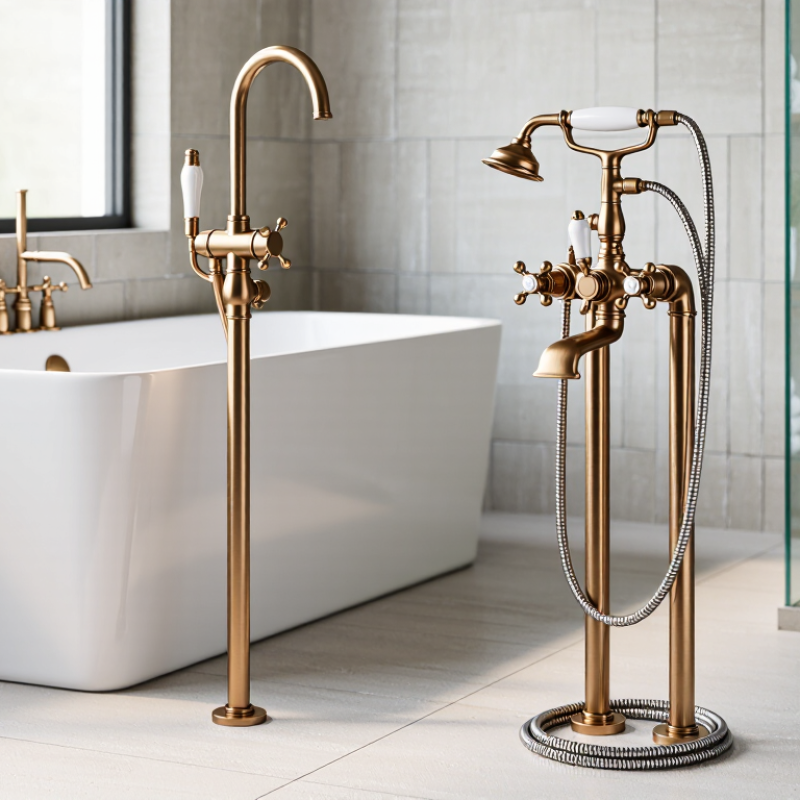
Freestanding tub fillers are standalone fixtures installed beside a bathtub, usually rising from the floor. They connect to concealed hot and cold water lines beneath the finished surface. Unlike wall-mounted faucets, they do not depend on a nearby wall for support. A typical unit includes a spout, hand shower, control handle, and flexible hose.
Their popularity comes from visual freedom. A filler can sit beside a sculptural tub without disturbing tiled walls. This creates a cleaner bathroom layout and gives designers more control over spacing. In practical use, the hand shower helps rinse soap and clean the tub. A well-made spout should deliver a steady stream without excessive splashing. Small details matter.
From hands-on product checks, installation accuracy affects performance more than many buyers expect. The floor connection must be strong, level, and positioned to match the tub’s rim. Water pressure, hose length, surface coating, and cartridge quality also deserve inspection. They are not perfect. Some models wobble when poorly anchored, and a long filler may feel awkward beside a compact tub. Maintenance access can be limited after flooring is completed. Buyers comparing Chinese manufacturers should request dimensional drawings, material information, leak-test records, and clear installation guidance before choosing a model.
Evaluating China’s leading freestanding tub filler manufacturers requires more than showroom appearance. Grand View Research reported continued growth in the global bathroom fixtures market through 2030. That growth increases supplier choices, but also raises quality risks. I would inspect factory experience, production equipment, and export records. A polished sample can mislead.
Ask for test reports covering flow rate, pressure resistance, cartridge durability, and surface corrosion. The U.S. EPA WaterSense program identifies 1.5 gallons per minute as a high-efficiency faucet benchmark. This helps compare water performance, even when products target different markets. Check compliance with ASME A112.18.1, CSA B125.1, or applicable local standards. Request traceable batch numbers. Confirm that the stated metal composition matches independent testing.
A reliable manufacturer should provide drawings, installation dimensions, spare-part lists, and clear warranty terms. Measure the sample yourself. Check whether the spout reaches the tub center without splashing. Turn the handle repeatedly. It should feel steady, not gritty. Inspect the flexible hoses and connection threads closely. Small defects matter.
Factory audits should review incoming material control, pressure testing, plating thickness, and final inspection records. Intertek’s 2024 consumer product quality research highlights the importance of supplier verification and documented controls. Still, reports do not replace practical testing. I would compare at least three production samples from different batches. One overlooked weakness remains common: after-sales support is often judged too late. Verify response times before placing a large order.
China’s Top 10 Freestanding Tub Filler Manufacturers are gaining attention as bathroom design shifts toward sculptural, floor-mounted fixtures. Grand View Research identifies bathroom fixtures as a growing global category, driven by renovation and premium residential projects. China remains important because its factories combine metal casting, cartridge assembly, surface finishing, and export logistics in one supply chain.
A credible top-ten selection should examine more than catalog appearance. I would compare brass grade, ceramic cartridge testing, coating thickness, salt-spray resistance, leak performance, and spare-part availability. Public factory audits, ISO 9001 systems, and documented pressure tests offer stronger evidence than polished showroom photographs.
The NKBA 2024 Design Trends Report also highlights wellness-focused bathrooms and freestanding tubs, supporting demand for tall fillers with hand showers and controlled water flow.
Details matter. A stable base should resist twisting on stone flooring. The handle should move smoothly, even with wet hands. Matte black looks modern, but it can reveal mineral spots quickly. That is easy to overlook. Export buyers should also verify thread standards, packaging protection, installation drawings, and after-sales response times. Many online rankings appear confident, yet few publish audited sales data. Therefore, “top 10” is better treated as a practical shortlist based on engineering, quality evidence, production experience, and international service capability—not an absolute market ranking.
China Top 10 Freestanding Tub Fillers Manufacturers
China’s top ten freestanding tub filler manufacturers often differ more in engineering than appearance. Most offer floor-mounted models with single-lever control, hand showers, and adjustable water outlets. Common materials include solid brass, 304 stainless steel, and zinc alloy components. Brass feels substantial, while stainless steel offers strong corrosion resistance. Zinc alloy can reduce cost, but its long-term performance deserves closer inspection.
Finish choices include polished chrome, brushed nickel, matte black, and PVD coatings. PVD usually resists scratches better than basic painted finishes. However, surface quality depends on preparation and thickness. A beautiful sample does not guarantee stable production. Buyers should request coating test results, cartridge-cycle data, and pressure-test records. Ceramic cartridges, silicone aerators, and flexible stainless-steel hoses are useful details. They improve control and simplify maintenance.
Design differences become clearer during installation. Slim round fillers suit modern bathrooms, while square bodies create a stronger architectural appearance. Taller spouts provide better clearance, but excessive height may increase splashing. Waterfall outlets look attractive, yet they can expose more surface area to mineral buildup. On real projects, installers also check base stability, hose access, and floor connection accuracy. A reliable manufacturer should provide dimensional drawings, spare parts, inspection reports, and clear warranty terms. Some suppliers communicate well but overlook packaging tests. That weakness can turn a flawless product into a damaged delivery.
| No. | Anonymous Manufacturer Profile | Typical Product Type | Primary Body Material | Common Finish Options | Valve / Cartridge | Typical Spout Reach | Typical Flow Rate | Design Difference | Common Market Positioning |
|---|---|---|---|---|---|---|---|---|---|
| 01 | Manufacturer Profile A | Single-handle floor-mounted filler | Brass body with stainless-steel hand shower | Polished chrome, brushed nickel, matte black | Ceramic disc cartridge | 200–230 mm | 7.5–9.5 L/min at 3 bar | Slim cylindrical column with concealed supply lines | Residential and hospitality projects |
| 02 | Manufacturer Profile B | Two-handle freestanding filler | Lead-free brass construction | Chrome, brushed gold, gunmetal gray | Ceramic disc valves | 210–250 mm | 8–10 L/min at 3 bar | Separate hot and cold controls with traditional detailing | Classic and transitional bathroom interiors |
| 03 | Manufacturer Profile C | Thermostatic tub filler | Brass body with thermostatic valve assembly | Brushed stainless steel, chrome, matte white | Thermostatic cartridge with safety stop | 190–225 mm | 7–9 L/min at 3 bar | Temperature control designed to reduce sudden heat changes | Premium residential and wellness applications |
| 04 | Manufacturer Profile D | Waterfall-style floor filler | Brass body with stainless-steel waterfall outlet | Chrome, brushed brass, matte black | Ceramic disc cartridge | 180–220 mm | 8–11 L/min at 3 bar | Wide open outlet creates a sheet-like water stream | Contemporary designer bathrooms |
| 05 | Manufacturer Profile E | Minimalist round-column filler | Low-lead brass with ABS hand-shower holder | Matte black, chrome, brushed nickel | Single ceramic cartridge | 195–215 mm | 6.5–8.5 L/min at 3 bar | Compact footprint suited to smaller bathrooms | High-volume residential and renovation supply |
| 06 | Manufacturer Profile F | Square-profile tub filler | Brass body with stainless-steel trim components | Brushed nickel, matte black, polished chrome | Ceramic disc cartridge | 205–240 mm | 7–10 L/min at 3 bar | Angular geometry coordinated with modern square fixtures | Modern residential and commercial interiors |
| 07 | Manufacturer Profile G | Hand-shower-focused filler | Brass body with metal hose and spray handset | Chrome, brushed nickel, oil-rubbed bronze | Ceramic cartridge with integrated diverter | 185–220 mm | 7–9 L/min at 3 bar | Longer hose and adjustable handset cradle for rinsing | Family bathrooms and practical renovation projects |
| 08 | Manufacturer Profile H | Wall-supported freestanding filler | Brass body with reinforced mounting plate | Chrome, matte black, brushed brass | Ceramic disc cartridge | 200–235 mm | 7.5–9 L/min at 3 bar | Additional wall or floor stabilization for rigid installation | New-build and heavy-duty installation projects |
| 09 | Manufacturer Profile I | Electronic touch-control filler | Brass body with electronic control module | Chrome, brushed nickel, matte black | Motorized ceramic valve or solenoid control | 195–230 mm | 6–8 L/min at 3 bar | Touch operation with optional temperature or timer functions | Smart-home and upscale hospitality applications |
| 10 | Manufacturer Profile J | Custom OEM/ODM tub filler | Brass, stainless steel, or mixed-metal construction | Custom PVD colors, chrome, painted finishes | Ceramic cartridge selected by project specification | 180–260 mm | 6–10 L/min at 3 bar | Flexible dimensions, logos, packaging, and finish matching | Private-label, project, and export orders |
Note: The specifications above represent commonly offered configurations in the Chinese freestanding tub filler manufacturing sector. Actual flow rate, materials, finishes, certifications, dimensions, and cartridge suppliers may vary by model and buyer specification. Flow rates are typically tested at approximately 3 bar dynamic pressure.
Choosing among China’s top freestanding tub filler manufacturers requires more than comparing catalog photos. ISO Survey 2023 places China among the world’s largest holders of ISO 9001 certificates, with more than one million certificates reported. However, ISO 9001 confirms management procedures, not automatically product quality. Request the certificate scope, factory address, and recent audit records.
Check the details closely. Ask whether the body uses brass or stainless steel, and request alloy reports for each production batch. Require pressure-test records, cartridge-cycle results, and plating or salt-spray data. A useful sample should arrive with its hose, fixing kit, installation guide, and spare seals. Test it with your project’s water pressure. A beautiful sample can still fail onsite.
Use UN Comtrade data carefully. HS 848180 covers many taps and valves, not only freestanding tub fillers. Export figures can show manufacturing scale, but they cannot verify consistency. Ask for three years of shipment references, defect rates, and inspection photographs. Confirm packaging dimensions before ordering; tall fillers often suffer corner damage. I would also compare two samples from separate batches. Small imperfections matter. A supplier may promise customization, yet struggle with one revised handle. That warning deserves attention. Check destination-specific compliance before production, because required testing varies by market.
Compare metal quality, cartridge testing, coating thickness, leak performance, and spare-part access. Catalog photos are not enough. A shortlist is not a final ranking.
Ask whether the body uses brass or stainless steel. Request alloy reports for each production batch. Material claims can be vague. Verify them.
Request pressure-test records, cartridge-cycle results, and salt-spray data. Test the sample with your project’s water pressure. A beautiful sample can still fail onsite.
The base should resist twisting on stone flooring. Check the fixing kit and mounting points carefully. A loose base feels unsafe and looks poorly installed.
The handle should move smoothly with wet hands. Check water-flow control and hose flexibility. Small flaws matter.
Matte black creates a modern appearance but may show mineral spots quickly. Light cleaning can become frequent. That detail is easy to overlook.
Request the certificate scope, factory address, recent audit records, and documented test results. Ask for installation drawings and spare-seal details. Documents still need checking.
Confirm packaging dimensions and corner protection before ordering. Tall fillers can suffer damage during handling. Request inspection photographs before shipment.
Export figures may suggest production scale, but they cannot prove consistent quality. Trade categories often include many tap and valve types. Shipment data needs context.
Compare samples from two separate batches. Watch for inconsistent finishes, revised-handle problems, or slow after-sales replies. Promises can sound better than performance.
Freestanding Tub Fillers are a stylish and practical solution for modern bathroom projects, combining independent floor-mounted installation with convenient water delivery to a freestanding bathtub. Their popularity comes from flexible placement, clean architectural lines, and a wide range of finishes and configurations. This article explains how to evaluate China’s leading manufacturers by examining production capability, quality control, certifications, customization services, delivery reliability, and after-sales support.
It also presents a carefully selected overview of ten prominent Chinese manufacturers without focusing on brand promotion, while comparing their typical product features, materials, valve systems, surface treatments, height options, and design styles. Readers will gain a clearer understanding of the differences between stainless steel, brass, and other commonly used materials, as well as the importance of durability and installation compatibility. Finally, the article provides practical guidance for choosing the right manufacturer according to project requirements, target market, budget, order quantity, customization needs, and long-term cooperation expectations.